2026 Washroom Services – FREE QUOTES PHONE TODAY
EXPLORE 2026 Washroom Services – FREE QUOTES PHONE TODAY



Delivering Excellence Since 2000
Contact Us
What is an AED and Why Does It Matter for Singapore Workplaces in 2026?
An Automated External Defibrillator (AED) is a portable device that delivers an electric shock to restore a normal heart rhythm during sudden cardiac arrest (SCA). In Singapore, approximately 2,300 people experience out-of-hospital cardiac arrest each year. Survival rates drop by 7 to 10 percent for every minute without defibrillation. AEDs used within the first three minutes can increase survival to over 70 percent.
Under the Workplace Safety and Health (WSH) Act, employers are legally required to provide adequate first aid facilities, trained responders, and — depending on workplace size and risk level — AED devices. This guide covers who can use an AED, where they mu
Who Can Use an AED in Singapore?
s to comply in 2026.Who Can Use an AED in Singapore?
AEDs are designed to be used by anyone, including untrained bystanders. The device provides audio and visual step-by-step instructions and will not deliver a shock unless it detects a shockable cardiac rhythm. However, the Ministry of Manpower (MOM) and the Singapore Resuscitation and First Aid Council (SRFAC) strongly recommend formal CPR+AED training for all designated workplace first aid responders.
A qualified workplace responder should:
- Be able to stay calm and act decisively under pressure
- Be physically and mentally fit to perform CPR and operate an AED
- Be available to respond immediately — able to leave their regular duties
- Complete a MOM-approved Occupational First Aid Course
Once certified, first aid licences are valid for three years. Refresher courses must be completed within th
Where Must AEDs Be Placed in Singapore?
ing this window requires starting the full course again.Where Must AEDs Be Placed in Singapore?
The Ministry of Health (MOH) and the Singapore Heart Foundation have progressively expanded the Public Access Defibrillation (PAD) programme. AEDs are now required or strongly recommended in:
- Shopping malls, MRT stations, and airports
- Hotels with more than 30 rooms
- Fitness centres and sports facilities
- Schools, universities, and government buildings
- Construction sites with 100 or more workers
- Any workplace where WSH risk assessment identifies cardiac risk as a hazard
For most commercial workplaces in Singapore, one AED per floor (or one per 100 workers, whichever results in a faster response time)
CPR+AED Training in Singapore: What You Need to Know in 2026
rly signed, accessible location — typically near common areas, lifts, or reception.CPR+AED Training in Singapore: What You Need to Know in 2026
The DARE programme (Dispatcher-Assisted first REsponder) offers a 45-minute hands-on CPR+AED course open to anyone aged 11 and above. For workplace compliance, the MOM requires a more comprehensive Occupational First Aid certification.
When choosing a training provider, confirm:
- The provider is listed on the MOM approved training centres list
- The instructor-to-student ratio is no greater than 1:6
- Mannequins are provided at a 1:1 ratio per student for practical sessions
- The course covers the SRFAC CPR+AED protocol (updated 20
The Step-by-Step AED Response Process
D guidelines in line with the 2025 International Liaison Committee on Resuscitation (ILCOR) recommendations. Ensure your training provider is delivering the current protocol.The Step-by-Step AED Response Process
A trained CPR+AED responder should follow this sequence:
- Assess the scene — check for hazards. Look for metallic or flammable objects near the patient.
- Check responsiveness — gently shake the patient and ask loudly, “Are you OK?”
- Call 995 — stay on the line. The dispatcher will guide you through the process.
- Send for the AED — ask a bystander to retrieve the nearest AED while you begin CPR.
- Begin CPR — 30 chest compressions to two rescue breaths (or hands-only CPR if untrained in rescue breathing).
- Attach the AED — expose the patient’s chest, attach pads as shown on the device. Check for a pacemaker (visible lump under the skin) and place pads at least 2cm away.
- Follow AED pro
How Many First Aid Responders Does Your Workplace Need?
dvise if a shock is needed. Ensure no one touches the patient during analysis or shock delivery. - Continue until paramedics arrive — do not stop CPR until SCDF takes over.
How Many First Aid Responders Does Your Workplace Need?
Under MOM guidelines:
- Workplaces with 25 to 100 employees must have at least one trained first aid responder
- An additional respo
Managed First Aid Kits and AED Support from Alsco
li>Higher-risk workplaces (manufacturing, construction, chemical) may require a higher ratio
A designated First Aid Coordinator should manage all responders, ensure kits are stocked, schedule refresher training, and brief staff on AED and first aid kit locations.
Managed First Aid Kits and AED Support from Alsco
Keeping your first aid equipment compliant and fully stocked is a legal obligation — and a practical one. Alsco Uniforms Singapore offers a fully managed first aid kit service that takes the administration off your hands. Kits are restocked on a regular cycle, always compliant with MOM requirements, and covered under an all-inclusive monthly fee with no upfront costs.
Ensure WSH compliance today. Contact Alsco about managed first aid kit services in Singapore.
Related Insights
14/06/2026
Fire Retardant Clothing in Singapore: What Every Safety Manager Needs to Know About FR Workwear, Fabric Technology and Sustainable PPE
20/05/2026
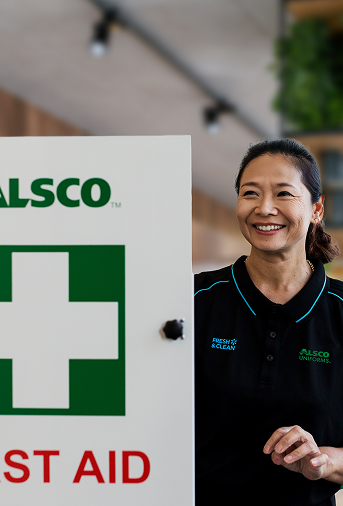
First Aid Services Singapore | First Aid Supplies & Kit Restocking | Alsco Uniforms
03/05/2026