EXPLORE 2026 Washroom Services – FREE QUOTES PHONE TODAY
EXPLORE 2026 Washroom Services – FREE QUOTES PHONE TODAY



Delivering Excellence Since 2000
Contact Us
Anti-Fatigue Mats in Singapore:
Published by Alsco Uniforms Singapore
Your floors are working against your staff. Every shift, every hour, every hard surface your team stands on is quietly doing damage. Tired legs. Aching backs. Slower reaction times. More mistakes. And eventually, more injuries.
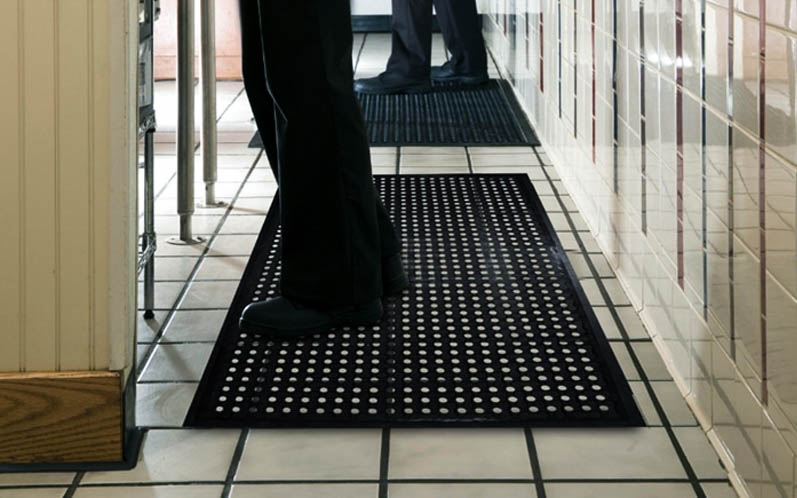
Anti-fatigue mats fix this. But not all businesses in Singapore know what they are, where to use them, or how to choose the right one.
This guide covers everything. What anti-fatigue mats are, how they work, which industries in Singapore need them most, what to look for when selecting one, and why a managed rental service beats buying outright every single time.
If your staff stand on their feet for a living, keep reading.
What Are Anti-Fatigue Mats?
Anti-fatigue mats are cushioned floor coverings designed to reduce the physical strain caused by standing on hard surfaces for extended periods. They work by encouraging subtle, continuous micro-movements in the muscles of the feet, calves, and legs. These micro-movements stimulate blood flow and reduce the pooling of blood in the lower limbs — the primary cause of fatigue, discomfort, and musculoskeletal pain in standing workers.
Put simply: hard concrete floors are static. Your body isn’t designed for static. Anti-fatigue mats bridge that gap.
They are manufactured from a range of materials including rubber, PVC, foam, and vinyl, each suited to different environments. Rubber mats are the industry standard for commercial and industrial use in Singapore, offering durability, grip, and resistance to oils, grease, and moisture. Foam and polyurethane mats are better suited to dry office or retail settings.
Thickness matters too. A mat that is too thin offers minimal cushioning. A mat that is too soft becomes unstable underfoot and can itself become a safety hazard. The sweet spot sits between 9mm and 19mm for most commercial applications, with heavier industrial environments benefiting from thicker, high-density variants.
The Real Cost of Ignoring Prolonged Standing
This is not about comfort as a luxury. It is about performance, safety, and your bottom line.
Research published by the National Institutes of Health (NIH) and cited by the Canadian Centre for Occupational Health and Safety (CCOHS) links prolonged standing in the workplace directly to:
- Lower back pain — one of the most common and costly occupational health complaints globally, with some studies recording rates as high as 40% among workers who stand for the majority of their shift
- Leg and foot pain — caused by poor circulation and constant pressure on joints
- Varicose veins — a direct result of blood pooling in the lower legs over time
- Musculoskeletal disorders (MSDs) — conditions that reduce long-term productivity and increase absenteeism
- General fatigue — which slows decision-making, increases error rates, and raises the risk of workplace accidents
- Cardiovascular strain — sustained standing increases cardiovascular load compared with alternating postures
These are not minor inconveniences. Workers experiencing physical fatigue make more mistakes, have higher rates of absenteeism, and are more likely to leave. The business cost of ignoring floor safety is significant: from workers’ compensation claims to reduced output, the financial impact adds up fast.
Anti-fatigue mats are one of the most cost-effective and immediately implementable ergonomic interventions available to any Singapore business.
Who Needs Anti-Fatigue Mats in Singapore?
The short answer: any business where staff stand for extended periods on hard flooring. In Singapore, that covers a wide range of industries.
Commercial Kitchens and Food Service
Singapore’s food and beverage sector is one of the most demanding environments for anti-fatigue matting. Kitchen staff, chefs, dishwashers, and front-of-house teams at hawker centres, restaurants, hotel kitchens, cafes, and catering facilities often stand on tile or concrete for eight to twelve hours a day.
The Singapore Food Agency (SFA) requires food businesses to maintain appropriate hygiene and safety standards on their floors. Anti-fatigue mats with drainage holes, grease-resistant nitrile rubber, and easy-to-sanitise surfaces are purpose-built for these environments. They reduce fatigue and they meet the hygiene requirements your kitchen demands.
What to look for: drainage channels for liquid run-off, nitrile rubber or PVC construction, grease and oil resistance, bevelled edges to prevent tripping, and compatibility with regular hosing and sanitising.
Manufacturing and Industrial Facilities
Factory floors and production lines across Singapore’s manufacturing sector — from precision engineering to electronics assembly to food processing — place workers on hard concrete for the duration of their shift. Prolonged standing in these environments contributes directly to musculoskeletal injuries and reduced output.
Under Singapore’s Workplace Safety and Health Act (WSHA), employers are required to maintain safe working conditions. Anti-fatigue matting is a recognised ergonomic control measure that helps employers meet these obligations.
Heavy-duty rubber anti-fatigue mats rated for industrial use provide both ergonomic support and slip resistance, even in wet or oily conditions. Modular tile formats allow coverage of large floor areas and easy replacement of individual sections.
Retail and Commercial Spaces
Retail staff in Singapore’s shopping malls, supermarkets, pharmacies, and specialty stores spend their entire working day on their feet. Standing at point-of-sale terminals, service counters, and display stations on hard tile floors is physically demanding work that is rarely acknowledged in operational planning.
In dry commercial environments, closed-cell foam or polyurethane mats offer excellent cushioning and a professional appearance. Anti-fatigue matting in retail settings also signals to staff that their employer takes their wellbeing seriously — a simple but meaningful demonstration of care that affects morale and retention.
Healthcare and Pharmaceutical
Surgeons, nurses, pharmacists, dental professionals, and laboratory technicians stand for extended periods in environments that demand precision and alertness. Fatigue directly undermines performance in these settings. The consequences are not just physical — they are patient safety and quality-of-care issues.
Pharmaceutical-grade anti-fatigue mats must comply with hygiene requirements, be resistant to chemical cleaning agents, and be free from harmful compounds. Anti-static variants are essential in environments where electrostatic discharge poses a risk to sensitive equipment or materials.
Hospitality
Hotel front desks, concierge stations, reception areas, spa treatment rooms, and event catering operations all involve staff standing for long periods on marble, tile, or timber flooring. These surfaces are chosen for aesthetics, not ergonomics. Anti-fatigue mats bridge that gap, providing comfort underfoot without compromising the professional appearance of the space.
Engineering and Trades
Mechanics, electricians, technicians, and tradespeople working at benches, under vehicles, or at fixed stations spend much of their day on hard concrete. This is particularly common in Singapore’s engineering, automotive servicing, and maintenance sectors. Rubber anti-fatigue mats designed for workshop environments provide cushioning, insulation, and grip in conditions where oils and fluids are present.
Government and Institutional
Security personnel, front-line government services staff, and institutional workers at counters and checkpoints across Singapore experience prolonged standing as a core part of their role. Anti-fatigue matting is a simple, low-cost investment that reduces occupational health risks in these settings.
Types of Anti-Fatigue Mats Available in Singapore
Understanding the different types helps you match the right product to your environment.
Dry Area Anti-Fatigue Mats
Designed for clean, dry environments such as offices, retail counters, and reception areas. Typically constructed from closed-cell foam, PVC, or polyurethane. Lightweight, easy to move, and often available in a range of colours and finishes to suit the aesthetic of the space.
Best for: Office standing desks, retail checkout counters, reception areas, pharmacy counters, front desks.
Wet Area Anti-Fatigue Mats
Built for environments where water, oils, or cleaning chemicals are present on the floor. Open-grid designs allow liquids to drain through rather than pooling on the surface. Nitrile rubber is the material of choice for wet areas due to its resistance to grease, chemicals, and moisture.
Best for: Commercial kitchens, dishwashing stations, food processing lines, workshops, wet manufacturing environments.
Heavy-Duty Industrial Mats
Engineered for the demands of factory floors, production lines, and heavy industrial environments. Built from high-density rubber or vulcanised compounds that can withstand heavy foot traffic, machinery vibrations, and exposure to oils and solvents. Often available in modular tile configurations for large-area coverage.
Best for: Manufacturing plants, food processing facilities, engineering workshops, automotive servicing bays.
Anti-Static Mats
Designed for environments where electrostatic discharge (ESD) is a risk. Provide grounding to prevent static electricity from building up in workers or on surfaces. Essential in electronics manufacturing, pharmaceutical production, and laboratories.
Best for: Electronics assembly, pharmaceutical production rooms, sensitive laboratory environments.
Safety Message Mats
Combine the ergonomic benefits of anti-fatigue matting with high-visibility safety messages or hazard warnings. Pre-designed or custom-printed with safety reminders, directional signage, or brand messaging. Fade-resistant printing and slip-resistant construction.
Best for: Factory floors, entry points, food preparation areas, high-traffic zones with safety communication requirements.
How to Choose the Right Anti-Fatigue Mat
Choosing the wrong mat creates new problems while solving none of the original ones. Here is what to consider.
1. Environment first. Is the area wet or dry? Are oils, grease, or chemicals present? Is the surface polished tile, painted concrete, or bare concrete? Match the mat material and construction to the environment. A foam mat in a wet kitchen is a hygiene and safety disaster.
2. Thickness and density. Thicker is not always better. A mat that is too soft creates instability, which increases tripping risk and can cause its own musculoskeletal strain. For most commercial applications, 9mm to 19mm is appropriate. Industrial environments with heavy-impact work may benefit from thicker, denser compositions.
3. Bevelled edges. All mats used in work environments should have sloped or bevelled edges. Square edges create a trip hazard. This is non-negotiable in any setting where people are moving quickly or carrying objects.
4. Slip resistance. The underside of the mat must grip the floor. Unanchored mats slide, bunch, and create exactly the kind of fall risk you are trying to prevent. Look for nitrile rubber backing or a strong-grip base.
5. Hygiene and cleanability. In food service and healthcare, mats must be compatible with your cleaning and sanitisation regime. Closed-cell materials resist moisture ingress and bacterial growth. Open-grid designs in wet areas should allow thorough hosing and drying.
6. Size and coverage. The mat should cover the entire standing zone. A mat that is too small forces workers to step on and off it constantly, eliminating most of the ergonomic benefit and increasing trip risk at the mat edges.
7. Durability. A mat that wears out, curls, or compresses within months is not cost-effective regardless of its purchase price. Industrial and commercial environments require mats built to sustain heavy use and regular cleaning without degrading.
Buy vs Rent: Why Singapore Businesses Are Choosing Managed Mat Rental
Purchasing anti-fatigue mats outright seems straightforward. You pay once, you own the mat. But the reality of mat ownership in a commercial environment is more complicated.
Mats wear out. They compress over time and lose their cushioning properties. They get contaminated with grease, bacteria, and debris that in-house cleaning cannot fully address. They curl at the edges. They need replacing — and when they do, you are back to the purchase cost again.
Beyond the mat itself, ownership creates administrative overhead. Someone needs to monitor condition, schedule cleaning, arrange replacements, and manage inventory. In a busy kitchen, factory, or retail operation, that time is rarely available.
Alsco Uniforms Singapore’s managed mat rental service removes all of this.
Here is how it works:
- No upfront capital outlay. You pay a simple monthly rental fee from as little as $1 per day. No large purchase order, no asset depreciation to manage, no balance sheet entry.
- Regular collection, cleaning, and replacement. Alsco schedules regular pickups, launders or sanitises your mats to commercial hygiene standards, and returns fresh mats on a set cycle. You always have clean, effective mats in place.
- Free repairs and replacements. If a mat wears out, curls, or is damaged, Alsco replaces it at no additional cost. You are never left operating with a substandard mat.
- Customisation included. Need mats with your corporate logo? Safety messages? Custom dimensions for unusual floor spaces? Alsco accommodates these requirements at no extra charge.
- Regulatory compliance, handled. For food businesses, Alsco’s mats and service protocols are aligned with Singapore Food Agency (SFA) hygiene requirements. For workplaces generally, the managed service supports compliance with the Workplace Safety and Health Act by ensuring mats remain in safe, effective condition at all times.
- Scalable. As your business grows, adds locations, or changes its floor configuration, the rental service scales with you. Add mats, change specifications, adjust delivery schedules. No lock-in to a purchased inventory that no longer fits.
The total cost of ownership for purchased mats — accounting for replacement cycles, cleaning labour, and compliance risk — consistently exceeds the cost of a managed rental service. For most businesses in Singapore, the rental model is simply the more intelligent financial decision.
Anti-Fatigue Mats and Workplace Compliance in Singapore
Singapore takes workplace safety seriously. The Workplace Safety and Health Act (WSHA) places a duty on employers to identify and manage hazards in the workplace. Slips, trips, and falls from inadequate floor safety are among the most commonly cited workplace incidents in Singapore — and they are largely preventable.
Anti-fatigue matting contributes to compliance in two ways:
1. Ergonomic risk reduction. Mats reduce the physical load on workers who stand for extended periods, directly addressing musculoskeletal disorder risk. Ergonomic controls are recognised under the WSHA as a practical measure for managing this risk.
2. Slip and trip prevention. Properly specified and maintained anti-fatigue mats with slip-resistant surfaces and bevelled edges reduce the incidence of falls, particularly in wet or oily floor environments.
For food businesses specifically, the Singapore Food Agency (SFA) requires appropriate floor hygiene and safety measures in food preparation areas. Anti-fatigue mats with drainage holes and commercial-grade hygiene properties form part of a compliant food facility floor setup.
When mats are managed under a rental service with scheduled cleaning and condition monitoring, businesses have a documented maintenance record — useful evidence of due diligence in the event of a workplace incident.
Where to Place Anti-Fatigue Mats in Your Singapore Workplace
Placement matters as much as specification. A mat placed in the wrong location, or covering only part of the standing zone, delivers a fraction of its potential benefit.
Fixed standing workstations: Any position where a worker stands in the same spot for more than 30 minutes continuously requires matting. This includes assembly line positions, food preparation stations, cashier counters, kitchen prep stations, and service desks.
Wet zones: Any floor area that becomes wet during normal operations. Dishwashing stations, cooking stations, industrial cleaning areas, food processing lines, and wet processing areas in manufacturing.
Entry points: High-traffic entry areas benefit from matting that combines entrance mat dust and moisture control functions with anti-fatigue properties for staff who are stationed at entry points.
Machine operating positions: Workers operating standing machinery or equipment, including lathes, presses, grinders, and packaging machinery, spend extended periods in a fixed stance. These positions are a priority for matting.
Counter positions: Hotel reception counters, pharmacy service counters, bank teller positions, information desks — any counter where staff stand for the majority of their shift.
The mat should extend at least 300mm beyond the edges of the standing zone in all directions where possible. This ensures the worker remains on the mat regardless of minor shifts in posture or position during the task.
The Bottom Line
Your staff are your most important asset. The floor they stand on directly affects how well they perform, how long they last in a shift, and how likely they are to stay with your business long-term.
Anti-fatigue mats are not a luxury. They are a practical, proven, low-cost ergonomic solution that reduces injury risk, improves productivity, and supports your obligations under Singapore’s workplace safety framework.
Choosing the right mat for your environment is important. Keeping it clean, maintained, and in good condition is equally important. That is exactly what Alsco Uniforms Singapore’s managed mat rental service is built to do.
From commercial kitchens to factory floors, from hotel receptions to pharmaceutical production rooms, Alsco has the mat specification, the managed service infrastructure, and the experience across Singapore’s key industries to deliver the right solution for your floor.
Enquire today. Get a quote. Put the right mat under your people.
Read More
5 Common Injuries and Their Basic First Aid You Can Easily Learn Today
How To Choose The Right Mat